
Event-Based Vision technology
What is Event-Based Vision?
The world does not move in frames.
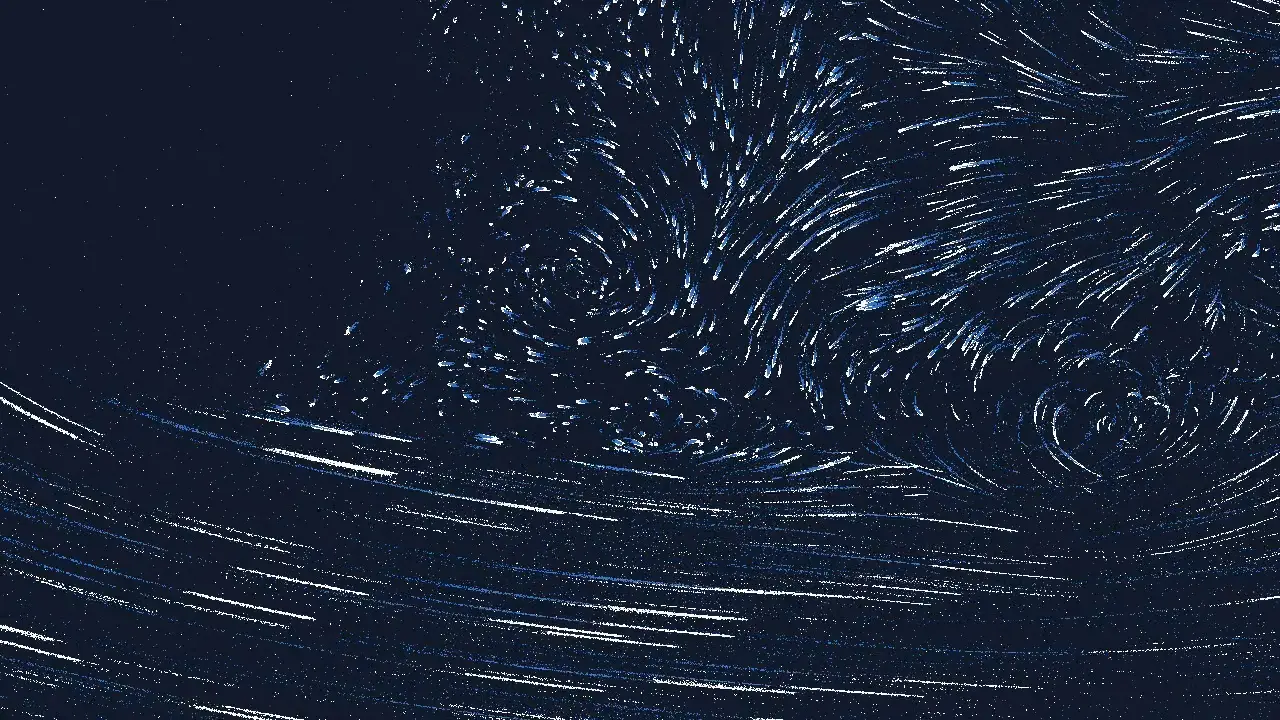
Event-Based Vision is a technology inspired by how the human eye acquires visual information. This neuromorphic machine-vision approach captures visual scene changes as they happen, while ignoring static parts of the scene. Instead of recording complete images at fixed intervals, each pixel of an event-based vision sensor responds independently and autonomously to local changes in light and generates precisely time-stamped events.
Together, these events create a sparse yet highly informative, continuous stream of visual data, efficiently describing the dynamics of the scene with microsecond-scale temporal precision and high dynamic range – while suppressing redundant data for responsive, power-efficient and always-on perception.
For more than a decade, Prophesee has pioneered and advanced this approach – from pixel-level sensing to complete perception systems – enabling machines to perceive what matters and act at the speed of change.
How does Event-Based Vision work?
Inspired by how the human eye acquires visual information, Event-Based Vision works fundamentally differently from conventional frame-based imaging.
A conventional camera captures a series of complete images at a fixed rate. Played in sequence, these images create the impression of continuous motion for a human observer. For machines, however, this often means repeatedly processing unchanged parts of the scene while fast changes can be missed between frames.
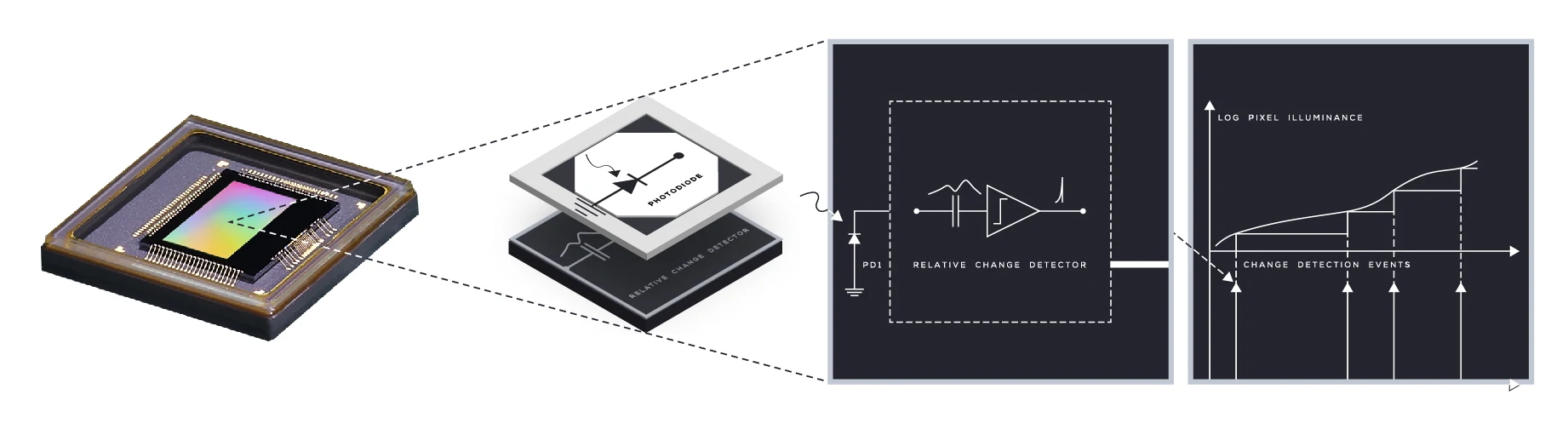
An event camera does not capture the complete scene again and again. Each pixel responds independently when a change in light crosses a defined threshold. It generates an event recording where and when the change occurred, and whether the light became brighter or darker.
Together, these events form a continuous stream of visual information driven by the dynamics of the scene – not by a fixed frame rate.
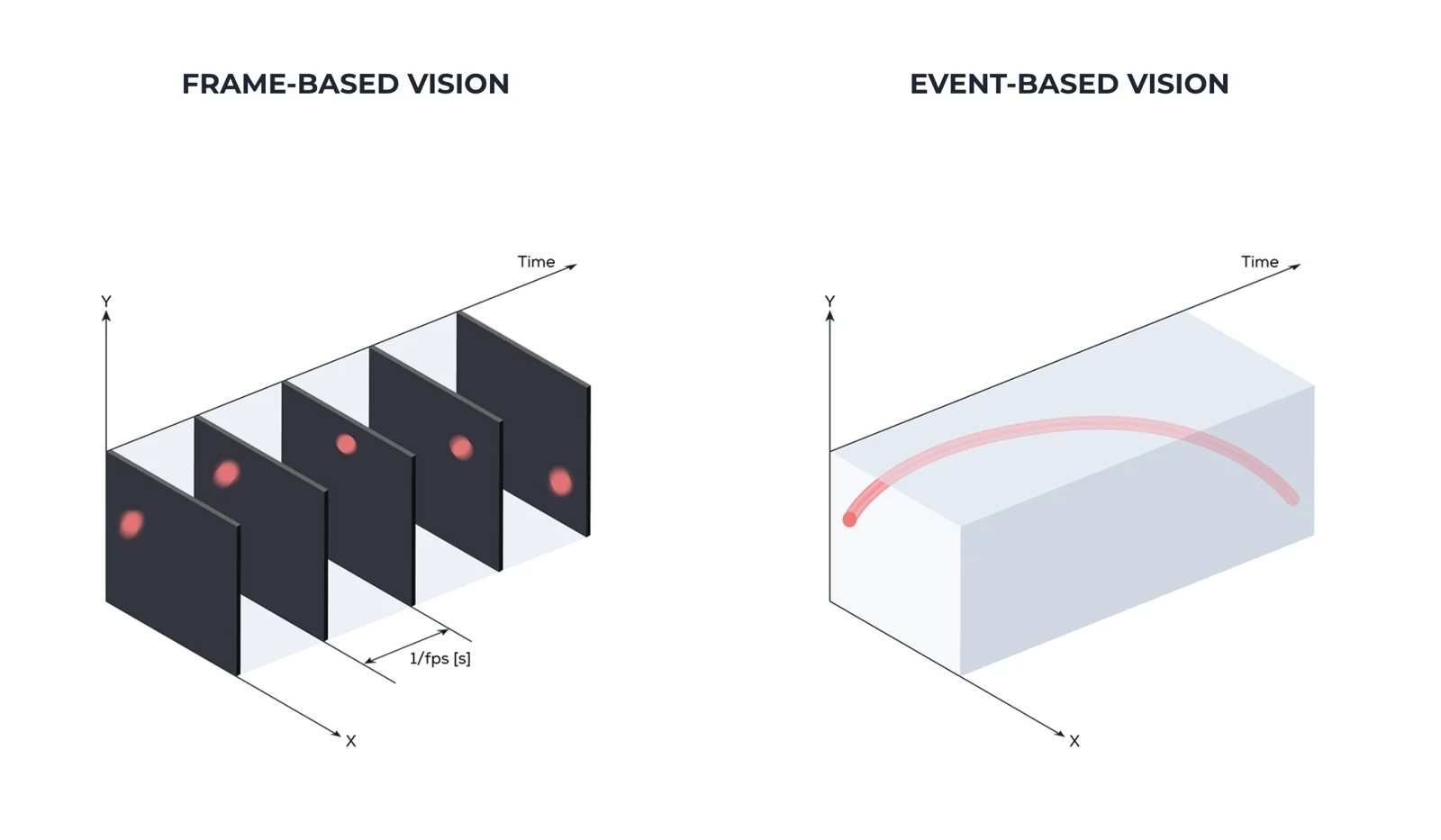
Reveal what happens between the frames
Seen as little dots, a frame-based simulation captures a spot on a rotating disc at 10 frames per second. Motion is reduced to a succession of still images, leaving what happens between them unrepresented.
Event-Based Vision responds instantly as the scene changes, pixel by pixel. Instead of waiting for the next frame, the pixels capture the movement as a precise stream of events, creating a time-continuous representation of the dynamics of the scene.
The XYT view makes the difference visible: motion becomes a consistent trajectory through space and time.
What data does an event camera produce?
Each event contains four essential values:
- XHorizontal pixel position
- YVertical pixel position
- TTimestamp in microseconds
- PPolarity: an increase or decrease in light intensity
Computer-vision algorithms and AI models turn these events into measurements, trajectories, detections and other application outputs.
Event-Based Vision versus frame-based vision
| Frame-based vision | Event-Based Vision |
|---|---|
| Frame-based visionCaptures complete images at a fixed frame rate | Event-Based VisionGenerates data continuously as the scene changes |
| Frame-based visionSamples all pixels simultaneously using a global or rolling shutter to capture each frame | Event-Based VisionAllows each pixel to respond autonomously and asynchronously |
| Frame-based visionRepeats information from unchanged areas | Event-Based VisionKeeps inactive pixels silent |
| Frame-based visionRepresents motion through a sequence of static snapshots | Event-Based VisionRecords continuous time-domain information without a fixed frame rate |
| Frame-based visionCan require higher frame rates, shorter exposures and more illumination to capture rapid movement | Event-Based VisionRecords precise points in time at pixel-level without an exposure window, revealing details between the frames with zero motion blur |
What are the advantages of Event-Based Vision?
Capture fleeting motion. Preserve detail across contrasting light. Reduce the data needed to understand the scene. These advantages can be especially valuable when speed, lighting and resource constraints meet.
Microsecond-scale Temporal resolution
Preserve the timing of fast motion and transient events without waiting for the next frame.
>120 dB Dynamic range
Detect relevant changes across scenes containing extreme differences between bright and dark regions, including backlighting, glare and rapidly changing illumination.
Orders of magnitude less data Scene-dependent data efficiency
By reporting changes rather than complete images, event cameras can substantially reduce the data transferred, stored and processed.
mW range Sensing power
Prophesee sensors operate within milliwatt-level power budgets, supporting compact, embedded and always-on visual systems.
Where is Event-Based Vision used?
Event-Based Vision is used in perception and measurement tasks where timing, dynamic range or data efficiency can determine system performance.
Defense and aerospace
Detect and track low-signature targets across ground, airborne and space missions within demanding size, weight, power, compute and bandwidth limits.
Industry
Capture fast-moving parts, transient defects, particles and subtle equipment changes for high-speed inspection, process monitoring and predictive maintenance.
Robotics and autonomous vehicles
Support navigation, obstacle avoidance, localization and dynamic-object tracking with precisely timed motion information and limited redundant data.
Infrastructure
Monitor movement, activity and physical change across transport networks, managed spaces and distributed assets without the constant full-frame video load.
Scientific imaging and research
Observe fluorescence events, microscopic particles, biological samples and rapidly evolving flows using sparse, precisely time-stamped data.
Mobile and wearable devices
Bring motion-aware imaging, eye tracking, gesture sensing and responsive perception to compact, power-constrained devices.
From photons to decisions
Prophesee advances Event-Based Vision across the complete perception chain – from patented pixel architecture to the software and intelligence that transform events into system-level information machines can interpret and act on.
01
Sense change
Scene change → Independent pixel events
Pixels, sensors, camera modules and evaluation systems generate precise, asynchronous event data.
02
Process event streams
Event stream X · Y · T · P
Development tools support camera configuration, event acquisition, visualization, filtering and transformation across PC and embedded environments.
03
Extract information
Algorithms + AI → Application information
Computer-vision algorithms and AI models extract application-relevant information from events, detect patterns, estimate motion or track objects.
04
Deploy perception
System response Real time
Embedded integration, application intelligence and complete systems turn event data into outputs that machines can act on in real time.
A different way to see. More ways to work together.
Event-Based Vision can operate independently or complement RGB, infrared, depth and other sensing modalities. Pairing event data with conventional images brings precise information about change together with color, texture and scene appearance. The right combination depends on what the system needs to perceive.
Advancing Event-Based Vision
Prophesee pioneered Event-Based Vision and continues to lead its evolution across the complete perception stack – from patented sensor architecture to development tools, software, application intelligence and deployable systems.
>100
Patents
66
International recognitions
60+
Scientific publications with Prophesee authorship
300+
Scientific publications featuring Prophesee technology
A global ecosystem of technology, research and industry partners












Research institutions, developers and industry partners use Prophesee technologies to explore new approaches to machine perception and bring Event-Based Vision into real operating environments.
See what becomes possible beyond frames
Explore the sensors, software and development tools that bring Event-Based Vision into real systems – or go deeper into the technology in our white paper.
Event-Based Vision FAQs
Does an event camera have a frame rate?
No. An event camera does not capture visual data at a fixed frame rate. Pixels generate events asynchronously when they detect pre-defined changes in light.
How is an event camera different from a high-speed camera?
A high-speed camera still captures complete frames, only at a higher frequency. This can resolve faster motion but usually increases data volume, illumination requirements and processing demand.
An event camera reports changes independently at each pixel, providing precise temporal information without repeatedly capturing the entire scene.
Why is event data blur-free?
A conventional image integrates light over an exposure period, allowing moving objects to blur across multiple pixel positions.
An event records the exact time at which a local brightness change crosses a threshold. It is not formed through a light exposure process. An event defines a point in time, hence, per definition, it cannot be subject to exposure-based motion blur.
Does Event-Based Vision always generate less data?
Data volume depends on how much of the scene is changing, the sensor configuration and the information required by the application.
Event-Based Vision can generate orders of magnitude less data in sparse or localized-motion scenes. Highly dynamic or noisy scenes may produce smaller reductions and require appropriate configuration and filtering.
Can an event camera produce conventional images?
The native output is an event stream rather than a conventional image. Events can be accumulated or reconstructed into image-like representations, and some systems combine event data with conventional image sensors when absolute intensity, color or texture information is also required.
Can Event-Based Vision work with AI and other sensors?
Yes. Event streams can be processed using computer-vision algorithms, AI models or combinations of both.
Event cameras can also complement RGB, infrared, depth, radar and inertial sensors by contributing precise motion and temporal information to a multimodal perception system.