
Overhead line equipment monitoring
Continuous detection between inspections
With Event-based Metavision® systems, detect missing catenary components and developing instability before they lead to damage, disruption, or costly emergency maintenance.
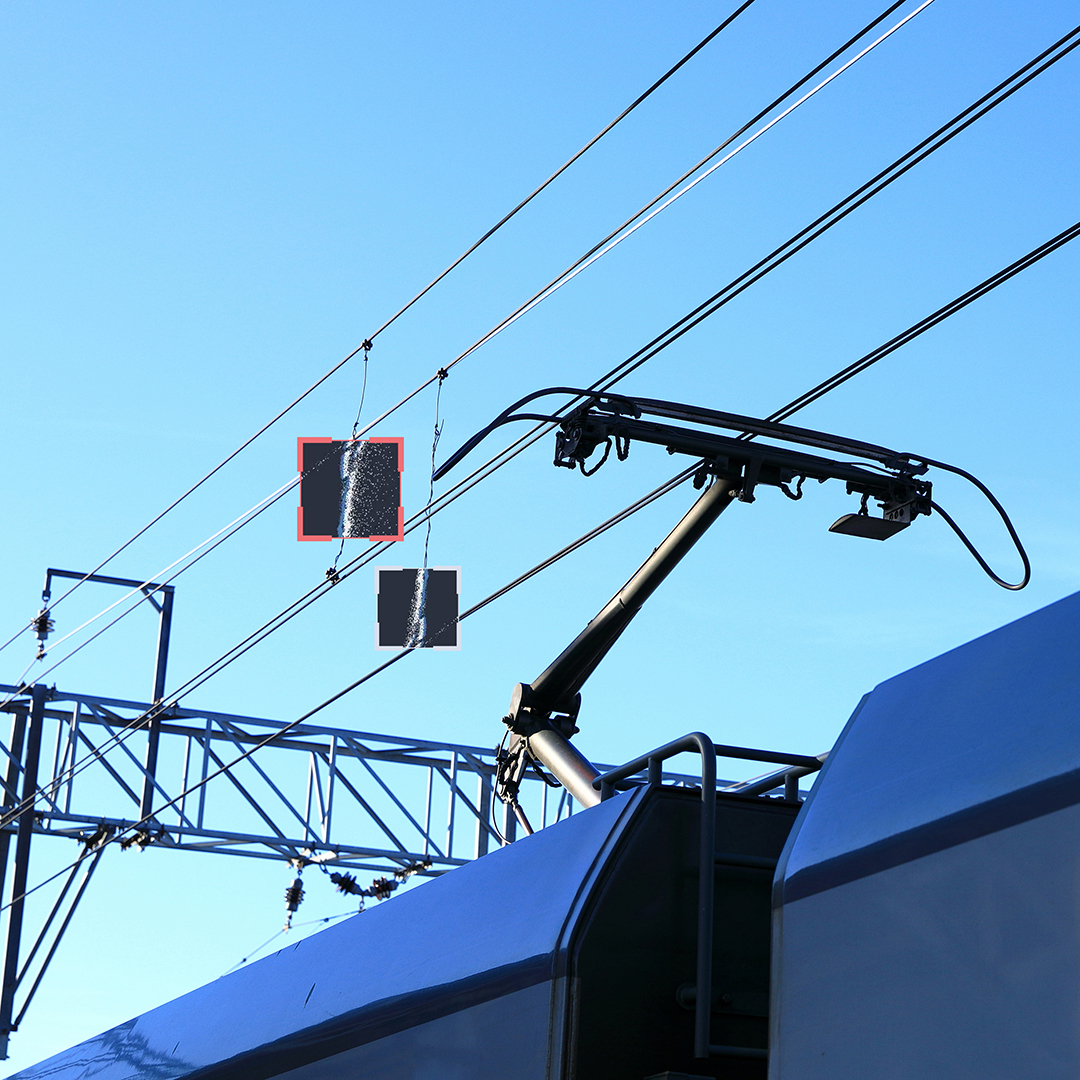
THE GAP BETWEEN INSPECTION CYCLES
Overhead line systems are typically inspected at fixed intervals, leaving long periods where infrastructure remains unobserved. During this time, catenary components can fail due to fatigue, ice loading, or vibration, and wire geometry can gradually shift under repeated train passes.
These changes are not visible between patrols.
As a result, failures are often only discovered during scheduled inspections or after a pantograph interacts with a degraded wire at line speed. At that point, the issue is no longer detection – it is the extent of the damage already caused.
THE COST OF REACTIVE MAINTENANCE
€1.2M
All-in cost per incident
~12 / year
Large network incidents
€14M
Annual reactive cost¹
Delay failures per incident
4,000
Delay minutes per incident
50
Cancellations per incident
¹ Published Network Rail and Ricardo benchmark, UK network. Busier routes run several times higher.
FROM PERIODIC INSPECTION TO CONTINUOUS VISIBILITY
Detect missing catenary components early
before wire sag becomes a risk
Identify developing instability
through changes in wire behavior
Target maintenance to specific spans
flagged from routine service runs
Trigger inspections based on real events
not fixed schedules
Reduce service disruptions
and emergency interventions
Optimize maintenance planning
and resource allocation
WHY EVENT-BASED VISION
Monitoring overhead line behavior requires detecting small, fast changes in dynamic environments – often under challenging outdoor conditions. Event-based vision is inherently suited to this:
Continuous motion sensing
real-time change detection, not static frames
Subtle movement detection
identifies oscillations and early instability
Reliable in complex lighting
works in glare, high contrast, and low light
Blur-free at high speed
maintains clarity at line speed
Low data footprint
40× lower than frame-based video
Ultra-low latency
immediate detection and response
REVEALING THE SIGNAL
Prophesee applies event-based vision through an onboard (pantograph-area) monitoring system designed for real-world rail conditions:
- Continuous monitoring of each span traversed during normal service
- Service runs used as natural sensing events
- Real-time detection of catenary component presence and oscillation behavior
- Comparison against a per-span baseline built across repeated runs
VALIDATION IN REAL OPERATING CONDITIONS
Prophesee’s validation protocol includes:
- 6-10 weeks of in-service monitoring on selected routes
- Operation across day/night, weather (rain, glare, ice), and speeds from 80 to 320 km/h
- Event tracking and verification against inspection records
- Automatic signal quality monitoring to ensure data reliability
- Optional controlled test event if no natural defect occurs
Result: an evidence-based assessment of detection accuracy, alert reliability, and operational value before broader deployment.
EXPLORE A PROOF OF CONCEPT
Evaluate continuous overhead line monitoring on your network and assess detection performance under real operating conditions.
Tell us about your project and we’ll get back to you shortly.
Explore other applications of event-based vision

RECOGNITION


