Event-based sensors are redefining machine vision by mimicking the human eye. Rather than capturing full frames at fixed intervals, each pixel reacts independently, sending data only when brightness changes or motion occurs. This means devices capture only what truly matters, significantly reducing data and energy load while improving speed and dynamic range. From drones to AR wearables or medical robots, these neuromorphic sensors enable smarter, more efficient edge-device vision.
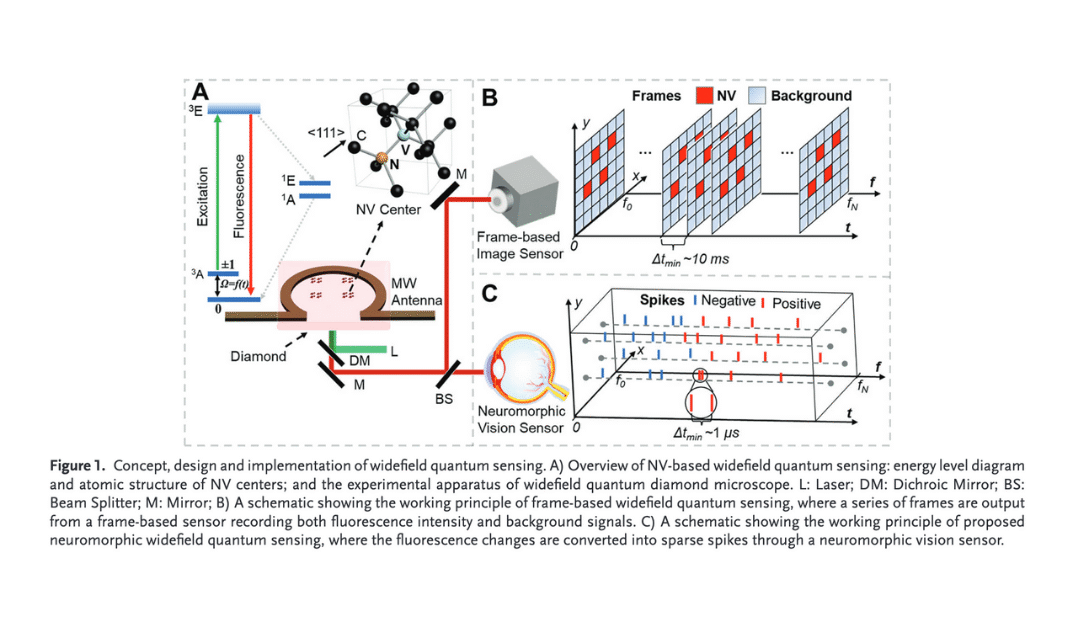
In this paper, a neuromorphic vision sensor encodes fluorescence changes in diamonds into spikes for optically detected magnetic resonance. This enables reduced data volume and latency, wide dynamic range, high temporal resolution, and excellent signal-to-background ratio, improving widefield quantum sensing performance. Experiments with an off-the-shelf event camera demonstrate significant temporal resolution gains while maintaining precision comparable to specialized frame-based approaches, and the technology successfully monitors dynamically modulated laser heating of gold nanoparticles, providing new insights for high-precision, low-latency widefield quantum sensing.
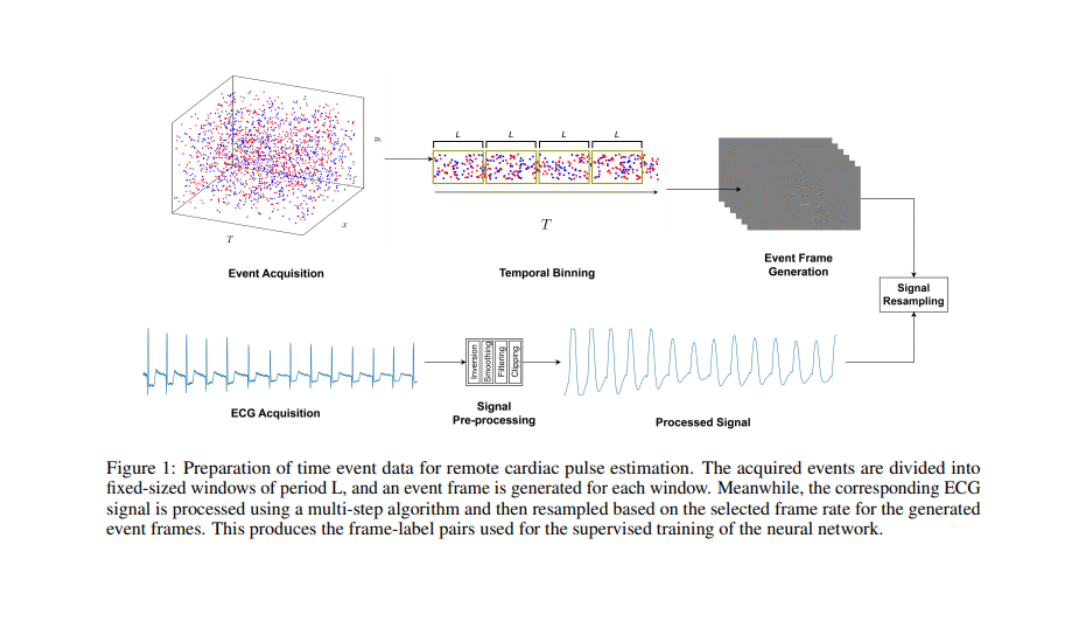
In this paper, the contact-free reconstruction of an individual’s cardiac pulse signal from time event recording of the face is investigated using a supervised convolutional neural network (CNN) model. An end-to-end model is trained to extract the cardiac signal from a two-dimensional representation of the event stream, with model performance evaluated based on the accuracy of the calculated heart rate. Experimental results confirm that physiological cardiac information in the facial region is effectively preserved, and models trained on higher FPS event frames outperform standard camera results.
In this paper, the contact-free reconstruction of an individual’s cardiac pulse signal from time event recording of the face is investigated using a supervised convolutional neural network (CNN) model. An end-to-end model is trained to extract the cardiac signal from a two-dimensional representation of the event stream, with model performance evaluated based on the accuracy of the calculated heart rate. Experimental results confirm that physiological cardiac information in the facial region is effectively preserved, and models trained on higher FPS event frames outperform standard camera results.
In this paper, a dynamic vision-based non-contact machine fault diagnosis method is proposed using the Eagle Vision Transformer (EViT). The architecture incorporates Bi-Fovea Self-Attention and Bi-Fovea Feedforward Network mechanisms to process asynchronous event streams while preserving temporal precision. EViT achieves exceptional fault diagnosis performance across diverse operational conditions through multi-scale spatiotemporal feature analysis, adaptive learning, and transparent decision pathways. Validated on rotating machine monitoring data, this approach bridges bio-inspired vision processing with industrial requirements, providing new insights for predictive maintenance in smart manufacturing environments.