Prophesee’s event-based vision for XR wearables is transforming smart glasses, delivering lightweight, high-performance devices with improved usability, low power consumption, precise eye tracking, and foveated rendering. Featured in Imaging & Machine Vision Europe, this technology addresses key XR challenges and enables more immersive, intuitive, and energy-efficient experiences.
CenturyArks’ SilkyEvCam HD Module, featuring the high-speed IMX636 HD event sensor realized in collaboration between Sony and Prophesee and a MIPI interface, delivers ultra-fast, low-latency event-based vision in a compact, lightweight design ideal for robotics, automotive, AGVs, and more.
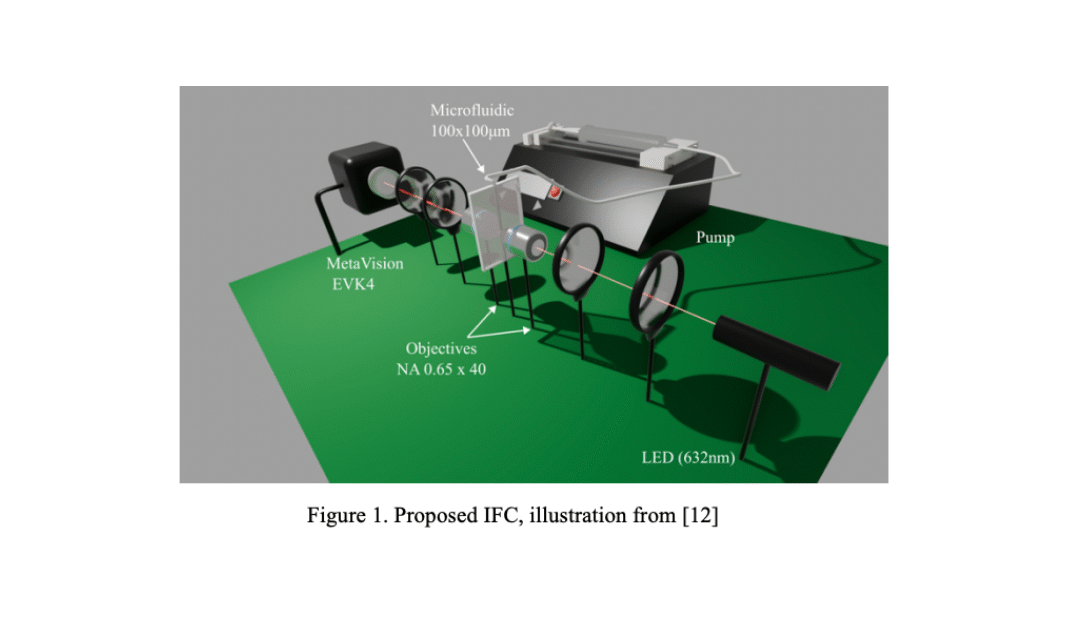
In this paper, an experimental imaging flow cytometer using an event-based CMOS camera is presented, with data processed by adaptive feedforward and recurrent spiking neural networks. PMMA particles flowing in a microfluidic channel are classified, and analysis of experimental data shows that spiking recurrent networks, including LSTM and GRU models, achieve high accuracy by leveraging temporal dependencies. Adaptation mechanisms in lightweight feedforward spiking networks further improve performance. This work provides a roadmap for neuromorphic-assisted biomedical applications, enhancing classification while maintaining low latency and sparsity.
In this paper, a novel probabilistic model is proposed that leverages the stochastic distribution of events along moving edges. A lightweight, patch-based algorithm is introduced that employs a linear combination of event spatial coordinates, making it highly suitable for specialized hardware. The approach scales linearly with dimensionality, making it compatible with emerging event-based 3D sensors such as Light-Field DVS (LF-DVS). Experimental results demonstrate the efficiency and scalability of the method, establishing a solid foundation for real-time, ultra-efficient 2D and 3D motion estimation in event-based sensing systems.
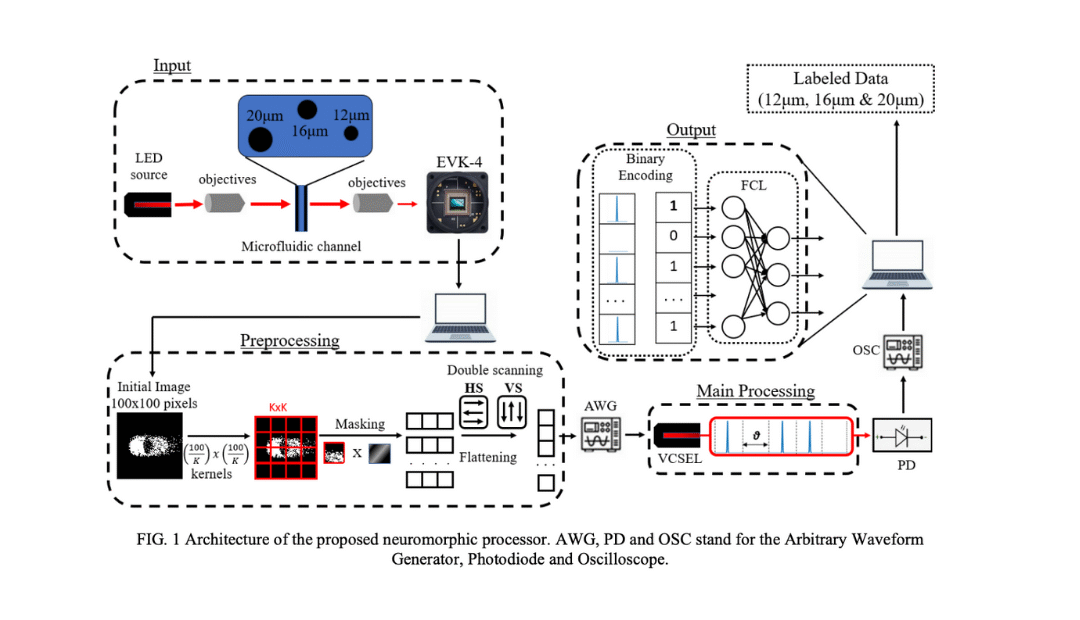
This paper presents a novel approach that combines a photonic neuromorphic spiking computing scheme with a bio-inspired event-based image sensor. Designed for real-time processing of sparse image data, the system uses a time-delayed spiking extreme learning machine implemented via a two-section laser. Tested on high-flow imaging cytometry data, it classifies artificial particles of varying sizes with 97.1% accuracy while reducing parameters by a factor of 6.25 compared to conventional neural networks. These results highlight the potential of fast, low-power event-based neuromorphic systems for biomedical analysis, environmental monitoring, and smart sensing.