


EVENT-BASED VISION ENABLES FASTER, MORE ROBUST STAR TRACKING FOR SPACECRAFT ATTITUDE ESTIMATION
Researchers at Kitware and the University of Dayton are have demonstrated how Event-Based Vision can advance star tracking, a key capability for spacecraft attitude estimation and space navigation.
Their research introduces EBS-EKF, an event-based star tracking method combining novel star centroiding with an extended Kalman filter. Using Prophesee’s EVK4 HD event-based vision camera, the team evaluated the method on real night-sky data and benchmarked it against a space-ready active-pixel sensor star tracker, demonstrating faster temporal sampling, greater motion tolerance, and accurate attitude estimation in dynamic conditions.
50x faster
temporal sampling compared to conventional APS-based star trackers
7.5°/s slew rate
robust tracking during faster camera motion
20 arcsec / 70 arcsec
accuracy
cross-boresight / around-boresight orientation accuracy
>100 Hz real-time
output
attitude quaternion and angular velocity estimation
High-frequency event-based star tracking from real night-sky data in action
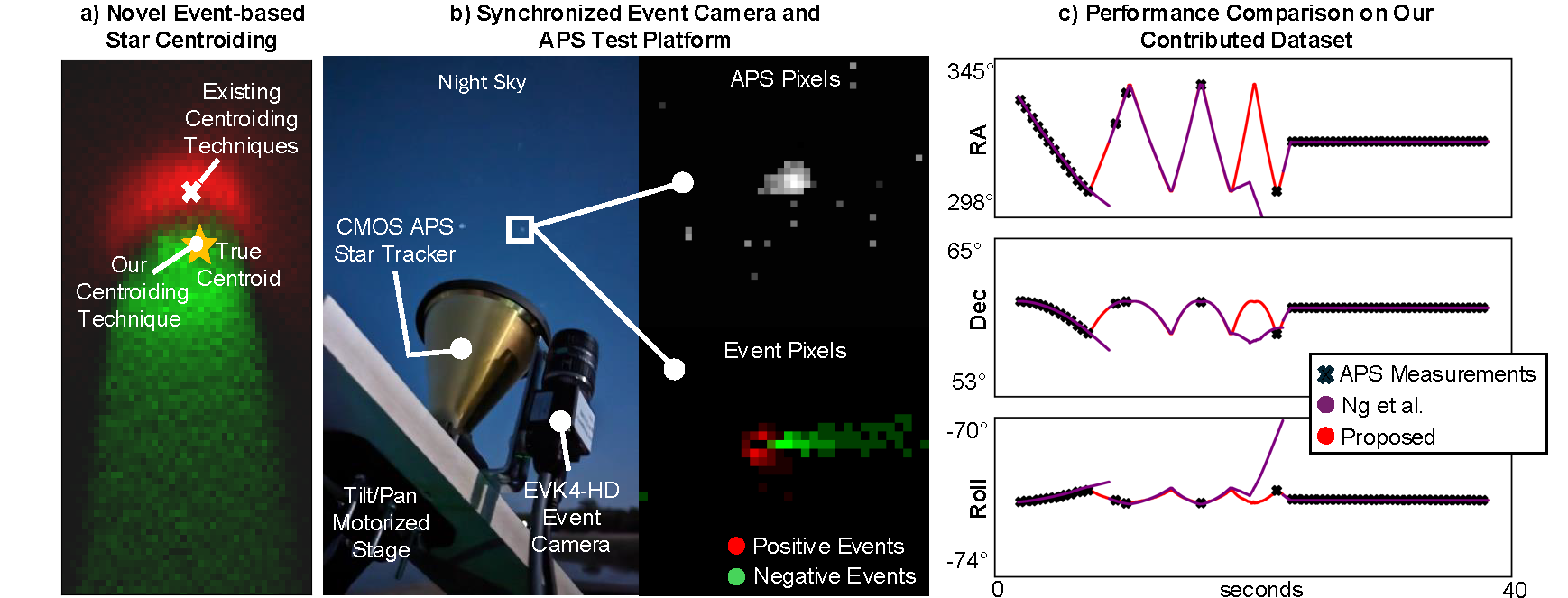
EBS-EKF – an event-based star tracking algorithm validated using the first ground-truthed dataset of event streams from real stars.
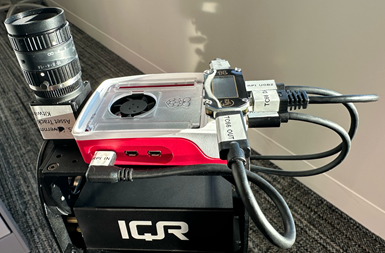
Demo setup with a Prophesee EVK4 HD event camera and Rasberry Pi on a motorized tripod
ADVANCING STAR TRACKING WITH REAL EVENT DATA
Star trackers estimate spacecraft orientation by observing stars and matching their positions against known celestial references. This makes them essential for guidance, navigation, and control.
Conventional star trackers can be limited during fast movement, where exposure time, motion blur, and frame-based update rates affect performance. Event-based sensing offers a different path: each pixel responds independently to brightness changes, allowing the apparent motion of stars to be captured as sparse, high-temporal-resolution event streams.
In this research, the Prophesee EVK4 HD event camera was synchronized with a space-ready APS star tracker to evaluate performance on real night-sky observations. The team reports more frequent updates and greater motion tolerance than conventional APS tracking, while achieving an order-of-magnitude accuracy improvement over previous event-based star tracking methods.
Dataset Example: Slow Oscillation
Dataset Example: Multipose
The project contributes technical resources to support further work in event-based star tracking.
By providing ground-truthed event streams from real stars, the research helps move event-based star tracking beyond simulation and toward quantitative evaluation with real astronomical observations.
To learn more, watch Kitware’s webinar for an in-depth view of the methods and results behind high-frequency event-based star tracking.
ABOUT KITWARE
Kitware is an open-source software research and development company with expertise in AI/ML, computer vision, visualization and data analysis, software and data engineering, and simulation.
ABOUT THE UNIVERSITY OF DAYTON
The University of Dayton is a research university in Ohio with engineering research activity across electrical and computer engineering, electro-optics and photonics, mechanical and aerospace engineering, and related disciplines.
ABOUT PROPHESEE INVENTORS COMMUNITY
Since 2014, a network of researchers, start-ups and companies have shown incredible imagination and innovation using Prophesee’s neuromorphic vision technologies.
This has created an Event-Based Vision ecosystem of inventors sharing their work and ideas. Their creativity with Prophesee’s technologies inspires us.
We are gathering them here to inspire future inventors in turn, in the hope that, like the projects here, they create something new together and reveal the invisible.


