
Use cases
Explore Event-Based Vision by use case
From counting objects at production speed and tracking low-signature targets to navigating without GPS and measuring microscopic flow, Event-Based Vision brings speed, precision and efficiency to the most demanding perception and measurement challenges.
Counting and metrology
High-speed counting
Count fast-moving parts, products and particles continuously without motion blur.
Particle and object-size monitoring
Measure the size, shape and distribution of moving objects and particles for continuous quality and process control.
Traffic data acquisition and vehicle counting
Measure vehicle movement, volume and traffic flow using sparse visual data processed at the edge.
Speed and velocity measurement
Calculate conveyor, component and object velocity from continuous pixel-level motion information.
Microfluidic particle measurement
Detect, count and measure microscopic particles moving through microchannels at high velocity.
Event-based imaging velocimetry
Track illuminated particles and reconstruct evolving velocity fields across air and water flows.
Inspection and defect detection
Foreign-object and particle detection
Detect contaminants, inclusions, spatter and other transient particles that can disappear between conventional camera frames.
Surface and defect inspection
Identify fast, subtle or short-lived defects during continuous production.
Overhead-line equipment inspection
Monitor catenary components, wire behavior and missing equipment from trains operating at line speed.
Continuous cell and contamination monitoring
Detect, track and classify cells and microbial contaminants in flowing samples for continuous biological measurement.
Process and condition monitoring
Vibration monitoring and predictive maintenance
Measure vibration remotely across multiple points to identify abnormal motion and developing equipment issues.
XYT motion analysis
Visualize movement across space and time to analyze fine mechanical and production dynamics.
Ultra-slow-motion analysis
Observe fleeting kinematic and process events at temporal resolutions equivalent to high-speed imaging.
Fluid velocity and flow monitoring
Measure the continuous movement and changing behavior of liquids within industrial processes.
Cable and yarn monitoring
Monitor cable velocity, yarn quality and slipping during continuous production.
Plume monitoring
Assess dispensing uniformity, dispersion coverage and fluid behavior for inline process control.
Structural condition monitoring
Measure vibration, oscillation and component behavior remotely to identify developing instability.
Remote-asset monitoring
Detect meaningful movement and physical change across distributed or power-constrained infrastructure.
Detection, presence and safety
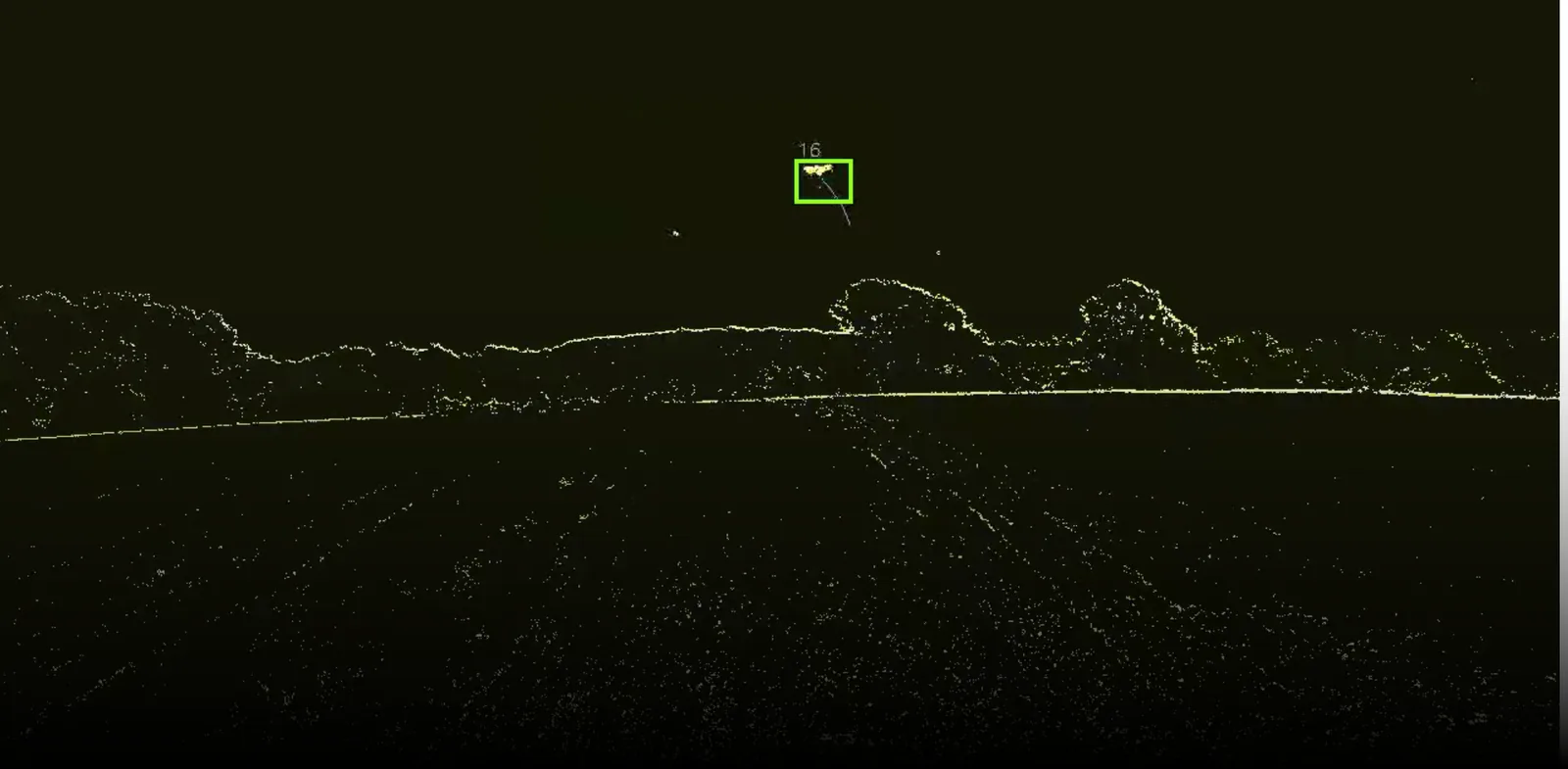
Ground-based drone detection and tracking
Detect and track small, fast and unpredictable aerial targets against cluttered backgrounds.
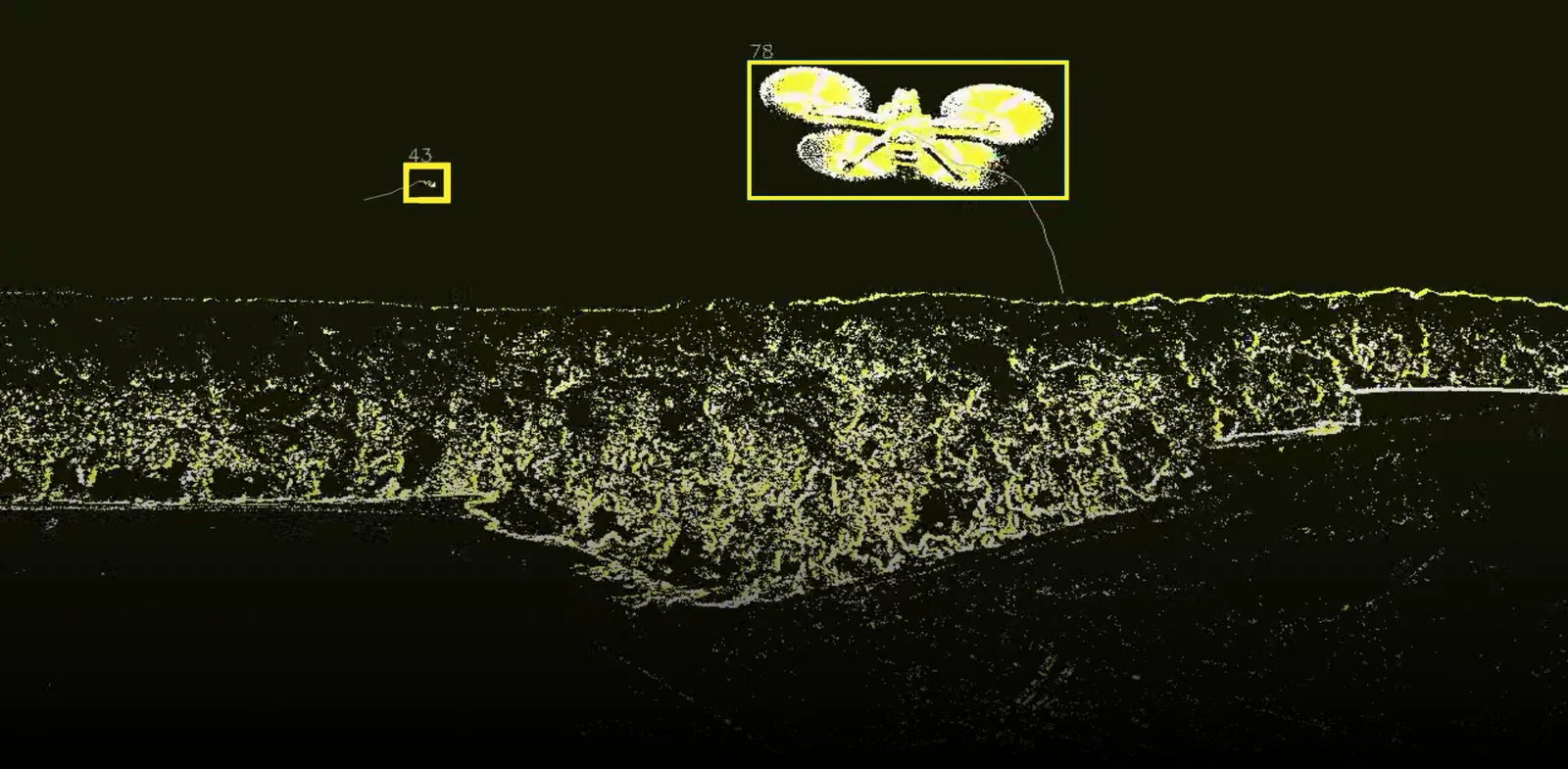
Airborne counter-UAS and self-protection
Bring responsive target detection, tracking and guidance onto SWaP-constrained airborne platforms.
Target detection and recognition
Use motion and temporal signatures to detect, track and help distinguish dynamic targets.
ADAS and collision avoidance
Detect fast-moving road users and support earlier vehicle response to emerging collision risks.
People counting and crowd monitoring
Monitor changing occupancy, crowd movement and people flow using sparse visual information.
Fall detection
Identify potential falls and trigger timely alerts using privacy-conscious, change-driven visual data.
Site and perimeter monitoring
Detect unexpected movement across secured sites, remote facilities and restricted areas.
Laser and pulse detection
Detect, localize and decode short-duration optical signals with precise timing.
Imaging, enhancement and scientific analysis
Motion deblurring
Combine event-based motion information with conventional imaging to reduce blur in fast-moving and low-light scenes.
Single-molecule localization microscopy
Capture fluorescence blinking as precisely time-stamped events for super-resolution molecular localization.
Label-free imaging flow cytometry
Analyze changing diffraction patterns to classify particles and biological samples with low latency.
Sight restoration and experimental visual assistance
Convert changes in the visual scene into stimulation patterns for experimental assistive-vision systems.
Biomedical vision systems
Apply sparse, time-resolved visual information to biological imaging, particle classification and experimental measurement.
Multimodal and specialized sensing
Multimodal sensing
Combine event data with RGB, infrared, polarization and other modalities to strengthen detection and recognition.
Gesture and hand tracking
Detect rapid hand movement and gestures for low-latency interaction in compact XR devices.
LED, flicker and temporal-signal detection
Detect rapid temporal signatures from vehicle, infrastructure and tracking LEDs beyond conventional frame rates.
Working on a different perception challenge?
Prophesee experts can help assess whether Event-Based Vision is suited to your application and define the appropriate path from feasibility testing to system integration.